Company OS: The Foundation of Chaos-Free Business in 2026
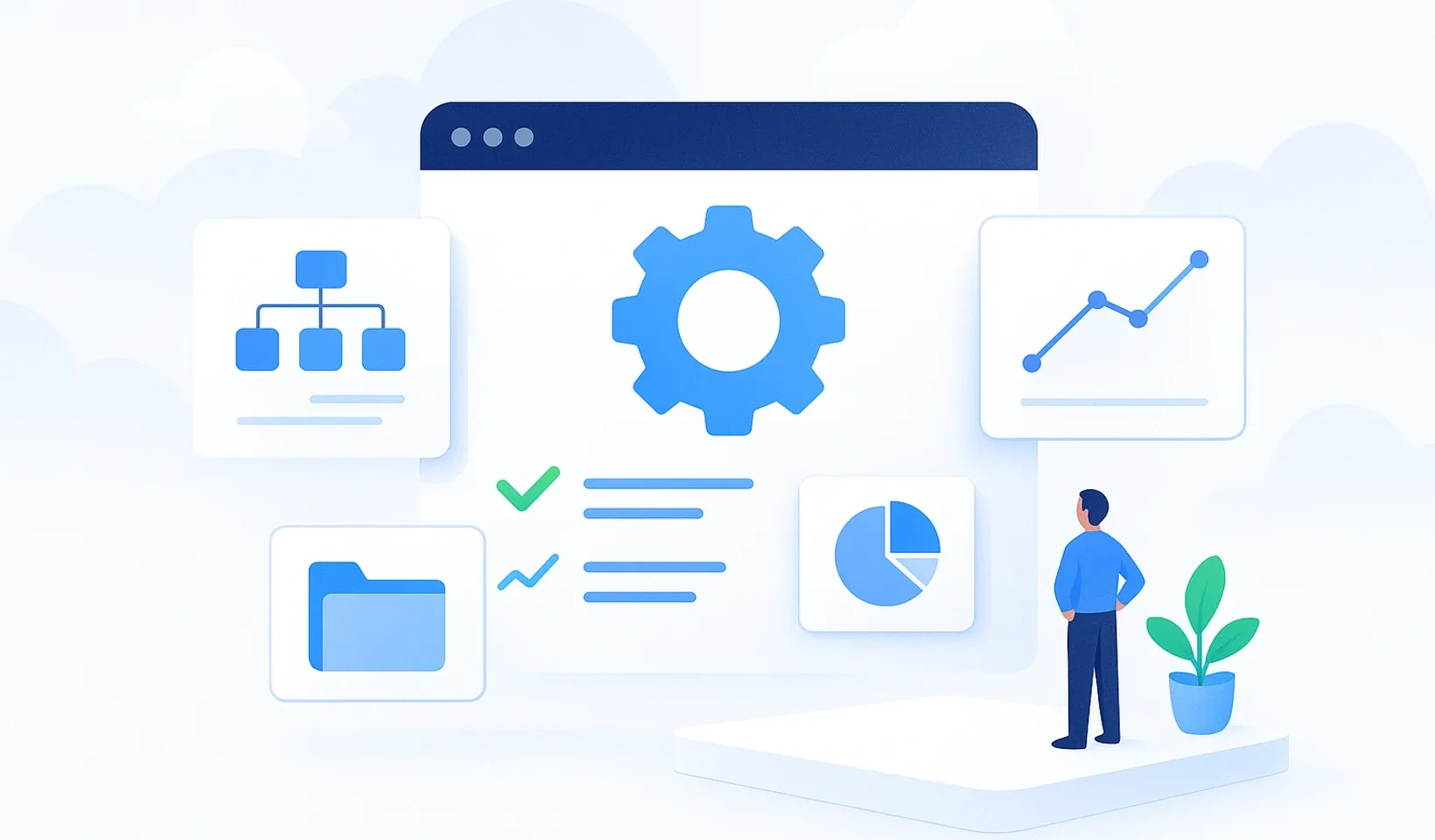
A company operating system (Company OS) is not the corporate edition of Windows, and it isn’t a software category either. It’s an operating principle: your company’s processes, knowledge and people live in a single shared system, not in ten scattered tools and three colleagues’ heads. For a small business, this means in practice that the “how we do it”, the “who knows what” and the “where our documents are” all live in one place, and that place is always up to date.
Company operating system (Company OS): the central system for your company’s operational knowledge: process descriptions, training materials, policies and documents in one place, with permissions, searchable, and connected to onboarding. It isn’t IT infrastructure, it’s the shared language of how you operate.
Why aren’t a folder structure and good intentions enough?
Most small businesses don’t build chaos on purpose; they just drift from tool to tool. The quote lives in email, the process description on Drive, the price list in an Excel sheet, and onboarding runs on “Joe will show you sometime.” On their own, each one works. Together, though, three things are guaranteed to be missing.
There is no single source of truth
Three versions of the same document live in three places, and nobody knows which one is official. A colleague works in good faith from last year’s price list, and it’s the customer who spots the mistake.
Knowledge is tied to people, not the company
Whatever only your most experienced colleague knows leaves with their resignation. This is called tribal knowledge: the knowledge needed to run the company lives in the memory of the “tribe”, written down nowhere. As long as everyone stays, the risk is invisible; the first time a key person leaves, it becomes very visible all at once.
Searching taxes your days like a hidden fee
If finding an answer takes five minutes of searching or interrupting a colleague, the company pays that a dozen times a day. The bill never arrives in one lump sum, so it’s easy to miss, but it’s concretely measurable in how onboarding drags on: at an undocumented company the same role takes two to three times as long to learn.
Tribal knowledge
When a key person leaves, the knowledge leaves too.
Slow onboarding
The new hire isn't self-sufficient for months.
Recurring mistakes
With no standard, everyone does it differently.
Searching
The answer exists somewhere, but nobody can find it.
What does a modern company operating system consist of?
You don’t need an enterprise ERP; four layers are enough, and each one is simple.
A searchable knowledge base
The foundation: your company’s documents in one shared, searchable space, in a structure that follows the way you work. The point isn’t the technology, it’s the agreement you make with the team: what’s here is official, and only what’s here exists.
Process descriptions
The building blocks of how you operate: short, step-by-step descriptions of recurring tasks. A good process description is 5 to 15 steps, one task, one owner; and these days you don’t even necessarily have to write it, because AI can draft it from a screen recording.
A training layer
A knowledge base becomes an operating system once it can also teach: your materials turn into a day-by-day onboarding plan with check questions, and you can see who’s where. The same content is at once a reference for veterans and training material for new hires; you don’t maintain it in two systems.
Official documents
Contracts, certifications, credentials: not training material, but part of how you operate. They get their own protected place inside the system, where you can pull them up in seconds during an audit, even from your phone.
How to roll it out in 5 steps
- Audit: list where your company’s knowledge lives today: Drive, Notion, email, heads. It doesn’t need to be a perfect list, the bulk is enough.
- Sorting: three piles: living knowledge (moves in), official documents (move into a separate, protected place), dead weight (stays). We don’t relocate the chaos.
- Migration: the sorted material goes into the new system. Here’s how to bring it over from Drive step by step; Word and PDF files become lessons automatically.
- Roles: who sees what, who edits what. Keep the principle simple: sharing = access, without a separate permission matrix.
- Launch: hand out the first onboarding plan, and announce the most important rule: whoever has a question searches the knowledge base first; whatever isn’t in there, we add.
The order isn’t random: whoever starts with step 3 just digitizes the chaos. The sorting and the structure are the real work, the migration is only minutes.
Before
- Scattered knowledge, three sources of truth
- Onboarding that drags on for months, hit or miss
- Recurring mistakes, everyone does it differently
- Heavy dependence on key people
After
- One shared, searchable knowledge base
- Day-by-day, trackable onboarding
- Written processes, consistent quality
- The knowledge belongs to the company, not one person
Where does Corganize fit in?
Corganize is a training and knowledge platform for small businesses: it gives you the four layers above in one place, deliberately without bureaucracy. Here’s what makes it different from classic training systems:
- Your structure, not ours. There’s no mandatory course-module-lesson scheme: you organize into folders, just like on your computer, up to six levels deep, with your own names, and you can rearrange them anytime by dragging.
- One piece of content, multiple roles. The same material can be an internal reference, a training lesson and even a public help article; you write it once and fix it in one place.
- Documents alongside training. Official documents get their own marked, protected archive in the same tree; you don’t have to pay for a separate document manager on top.
- AI where it actually helps. A process description draft from a screen recording, a neatly organized lesson from messy imported material in one step; for us AI is an editing assistant, not a magician.
- Built for small businesses. The interface, the help and the support alike.
Ultimately, a company operating system isn’t a software question, it’s a decision: that your company’s knowledge should belong to the company, not to chance. The software only decides how much work that decision takes.
Frequently asked questions
What's the difference between a company operating system and plain cloud storage?
Storage holds files; a company operating system holds how you operate: it knows the official description for each process, who has access to what, and who has learned what. Storage is the shelf; the operating system is the librarian, the trainer and the record all in one.
How long does the rollout take at a small business?
Sorting your existing materials takes a few hours, the migration takes minutes, and the real work is reviewing and structuring. A small business typically reaches its first assigned onboarding plan in 1 to 2 weeks, and the system keeps growing after that.
Do I need an IT person for it?
No. If you can manage folders on your computer, you can manage the knowledge base too: the structure is the same folder tree, uploading is drag-and-drop, sharing is one click. The rollout is organizational work, not IT work.
Can I use my existing Google Drive files?
Yes. Google Docs can be downloaded in Word format, and once uploaded into Corganize folder and all, they automatically become lessons, images included; PDFs too. You can also import a Notion export directly.
What size company is it for?
For any where knowledge no longer fits in one or two people's heads: typically from 5 to 10 people. There's no upper limit based on headcount, only on need: if onboarding, processes and document order are a daily pain, you're big enough.
Is my data safe in a system like this?
In Corganize each company's data lives separately on a European server with daily backups. You assign access: everyone only sees what you've shared with them, and official documents live in a separate, protected archive.
Your company's operations, in one system
Corganize is a training and knowledge platform: your processes, your training materials and your official documents in one place, following your own folder logic. It doesn't add bureaucracy, it takes it away.
Request access